Foods That Sabotage Your Weight Loss: Good vs. Bad
Aug 13, 2026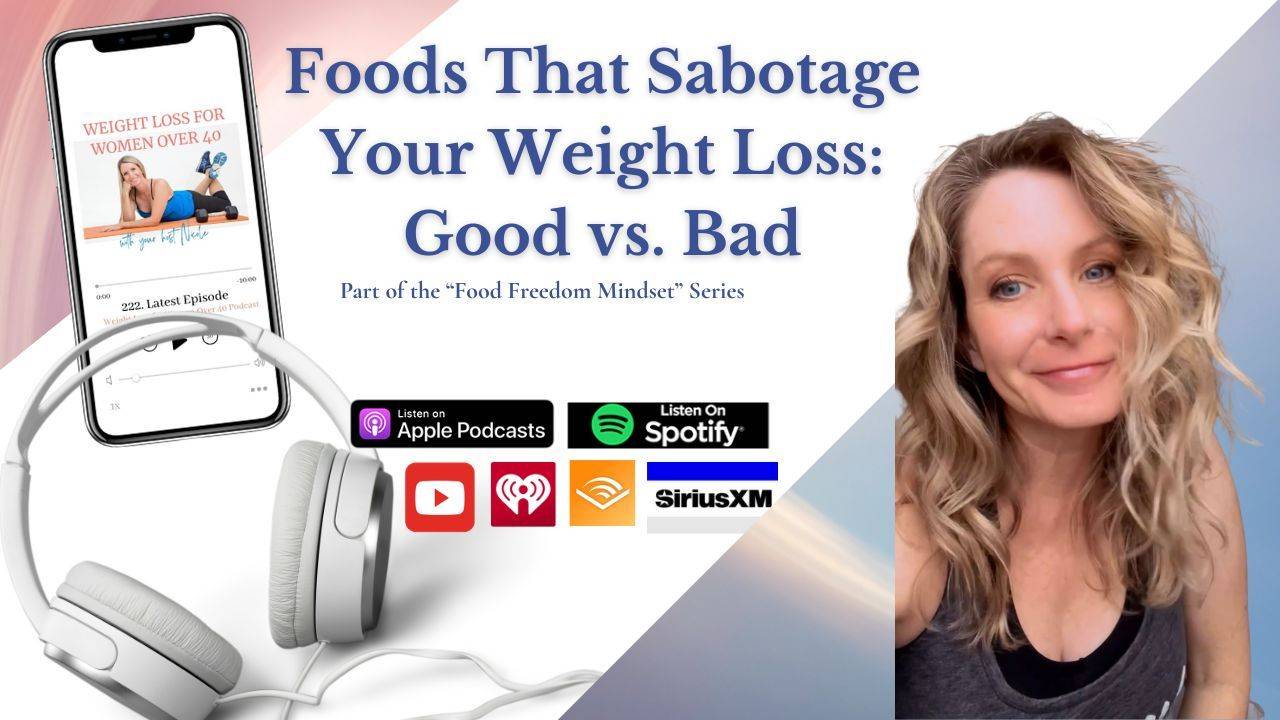
Foods That Sabotage Your Weight Loss: Good vs. Bad
Food Freedom Mindset Series
Are certain foods really sabotaging your weight loss—or is it the way you've been taught to think about food?
In this episode of Weight Loss for Women Over 40 launching the Food Freedom Mindset series, Nicole Ternay breaks down the good food vs. bad food mentality and what may actually be keeping you stuck. From restriction and rebound eating to emotional eating, food guilt and eating on autopilot, you'll learn why lasting weight loss has less to do with finding the "right" foods and more to do with understanding yourself.
Because food isn't the enemy. Your relationship with food is where the real work begins.
It's time to stop fearing food, stop starting over, and start building trust with yourself.
If you are tired of using exercise as a way to fix yourself, this episode will help you create a new relationship with movement…one built on compassion, strength, and becoming the woman you were meant to be.
If you’re realizing this isn’t just about food tips or fitness advice...and you’re ready to transform your relationship with your body, your identity, and your next chapter...we’d love to welcome you. Join the MavenHeart Membership today and step into a community where you truly belong. If you are ready for more personalized help apply for private coaching HERE.




Foods That Sabotage Your Weight Loss - Good vs. Bad
Food Freedom Mindset Series
Are There Really Foods That Sabotage Your Weight Loss?
Let's talk about something that has created way more confusion around food than it ever needed to: good food versus bad food.
We talk about foods that supposedly make you lose weight, foods that make you gain weight, foods you can eat without guilt, and foods you're supposed to avoid like the plague. After decades of being told what we should and shouldn't eat, it's no wonder so many women still don't trust themselves around food.
So I want to flip that conversation.
Because while there are certainly differences in the quality and nourishment of foods, I don't want you walking around believing that certain foods are morally good and other foods are morally bad. A sweet potato and a cookie aren't nutritionally identical. We know that. But that's not the conversation we're having today.
The conversation is about what happens when you give food a meaning that it was never meant to carry.
Because the food isn't necessarily the problem.
Your relationship with food might be.
This is the first episode in my Food Freedom Mindset series, and the goal is to get you looking at food through a completely different lens. Not through a dieter's mentality. Not through fear. Not through another set of food rules.
Through awareness.
When you understand what is actually happening with your choices, you don't need another list of foods you're allowed to eat or not allowed to eat.
You need to understand yourself.
Why Labeling Foods as Good or Bad Can Backfire
Think about all the things you've heard.
Bread is bad.
Sugar is bad.
Carbs are making you gain weight.
Don't eat after 7 p.m.
You can't have this.
You shouldn't eat that.
You need to eliminate certain foods if you want to lose weight.
This is not new information. Some version of these rules has probably been part of every diet you've ever tried.
And here's what tends to happen.
You decide you're going to be "good."
You clean up your eating. You meal prep. You get organized. You remove all the foods you've decided are bad from your kitchen. You feel incredibly motivated.
And for a while, it works.
Until it doesn't.
Eventually, you want the thing you've told yourself you can't have.
Now it's not just food anymore. It's become forbidden.
Something you want to sneak out and buy. Something you might eat in private. Something you've decided you shouldn't have.
And because you've already labeled it bad, you don't necessarily have a little.
You think, "Well, I already blew it."
So you might as well finish the whole thing.
That is the restrict-and-rebound cycle in action.
The "I Already Blew It" Mentality
I know this mentality because I've lived it.
For me, Cameo cookies were one of those foods. I could tell myself I wasn't going to eat them, and then the minute I decided I couldn't have them, they became incredibly compelling.
There were probably occasions when I actually ate the entire package.
And I get the mentality behind it.
If I'm going to eat it anyway, I might as well eat all of it and get it over with.
If I eat it really fast, maybe it didn't happen.
If I already messed up, I'll just start over tomorrow.
Sound familiar?
This is where shame and guilt start creeping in.
Then comes the promise to start over.
Tomorrow.
Monday.
After the weekend.
After vacation.
After the holidays.
I call Sunday the "Last Supper" sometimes because Sunday becomes this final opportunity to eat everything you're not going to allow yourself to eat once Monday arrives.
And then Monday comes, and you're going to get your shit together.
Until the cycle starts again.
Suddenly, food isn't simply food anymore.
It's loaded with emotion.
Food Is Neutral Until We Give It Meaning
This is the part I really want you to pay attention to.
Food can be completely neutral in your life until you give it meaning.
A cookie is a cookie.
It's an inanimate object. It's a combination of ingredients sitting on a table.
You can eat a cookie and move on with your day.
Or you can eat that same cookie and immediately think, "I shouldn't have done that."
Same cookie.
Completely different relationship.
And that relationship matters.
I'm not saying every food supports your body in exactly the same way. Of course it doesn't. Different foods can affect your energy, hunger, fullness, satisfaction and overall nourishment differently.
And that's individualized, too.
One person might eat a particular food and feel fantastic. Someone else might eat the exact same thing and not feel great at all.
That's very different from labeling food as morally good or bad.
More importantly, I want you to stop making your food choices a reflection of whether you are good or bad.
You're not good because you ate a salad.
You're not bad because you had pizza.
You're not disciplined because you skipped dessert.
You're not out of control because you had two pieces of cake.
You're a human being eating food.
That's it.
The mindset behind the choice is where the real conversation begins.
What Actually Can Sabotage Your Weight Loss?
If we're going to talk about what sabotages weight loss, let's talk about the things that actually make losing weight harder.
Because there are absolutely patterns that can get in the way. Most of them have very little to do with one particular food.
One of the biggest is the restrict-and-rebound cycle.
You restrict the foods you think you can't eat. Then you become hungry. You start thinking about food more and more. Eventually, you eat more than you intended. Then guilt and shame show up, and you decide you need to restrict again.
And the cycle continues.
If you've been doing this for years or decades, you might genuinely believe the problem is that you can't control yourself.
But what if the problem isn't your lack of control?
What if you've simply been conditioned into a pattern where you're constantly trying to control yourself?
That's a very different problem.
Hunger, Food Preoccupation and the Restriction Cycle
There's an important distinction here between physical hunger, mental hunger and emotional hunger.
When you restrict and push past physical hunger, your brain isn't going to calmly say, "No problem. I'll just stop thinking about food."
Your primitive brain is trying to keep you alive.
So when you're hungry and continue ignoring that hunger, food can become increasingly difficult to stop thinking about. You become preoccupied. You get hangry. You're thinking about when you're going to eat, what you're going to eat and how much you're going to eat.
Eventually, you may eat more than you intended.
Then comes the guilt.
Then the shame.
Then the promise to start over.
And you're right back at restriction.
That doesn't mean you have no willpower.
It means there's a pattern happening that you need to understand.
Eating Without Awareness
Another pattern that can sabotage your weight loss is eating without awareness.
And I want to be clear: eating without awareness doesn't make you a bad person.
It means you're disconnected from what's happening while you're eating.
Maybe you're standing in the kitchen eating while you're making dinner.
Maybe you're working through lunch.
Maybe you're scrolling while you're snacking.
Maybe you're eating because you're stressed, bored, tired or simply because food happens to be sitting in front of you.
For me, I know I'm a pretty fast eater. But I also know when I've had enough. I know when I've moved past the point where I feel comfortable.
The problem is that when we're distracted while we're eating, it becomes much harder to recognize those signals.
You don't have to become perfect at mindful eating.
You don't have to sit in silence and meditate over every bite.
You simply need to become more aware.
Because awareness gives you choices.
And choices are what we're after.
Not perfection.
Choices.
Decisions.
Emotional Eating Isn't a Character Flaw
Another pattern that can get in the way of weight loss is using food to regulate every uncomfortable emotion.
And I'm not here to tell you emotional eating is horrible.
Sometimes food is comforting.
Sometimes you eat something because you love it and that's exactly what you want to do.
I've done this myself.
When I was going through my divorce and preparing to leave, I found myself seeking comfort in food. I didn't want to turn to drugs or alcohol, so food became a soothing mechanism for me.
There is no shame in that (especially because of the program I have designed I have the tools to lose weight whenever I choose to).
The question is whether food has become your only strategy for coping.
If every stressful day ends with food or loneliness automatically sends you to the kitchen, that's worth looking at.
If you reward yourself with food every time you've had a really hard day or you're using food to numb feelings you don't want to feel, that's worth investigating.
Not because you're doing something wrong.
Because there's information there.
The work isn't necessarily finding a "better" food.
The work is expanding your toolbox.
You don't need to take comfort away from yourself.
You need more ways to experience comfort.
You Don't Have to Earn Your Food
Here's another one that gets overlooked: eating food you don't even enjoy because you've decided it's "good for you."
You know exactly what I'm talking about.
You're sitting there eating something that tastes like cardboard because you've convinced yourself that this is what healthy women do.
Meanwhile, you're thinking about the food you actually want.
That doesn't feel like freedom to me.
There is absolutely nothing wrong with choosing nourishing food because you genuinely want to feel good. I want you to fuel your body well. I want you to understand how food supports you.
But I don't want you spending the rest of your life eating foods you hate in an attempt to become a smaller version of yourself.
That's not the life we're building.
Better Questions to Ask Yourself About Food
Instead of asking, "Is this food good or bad?" start asking yourself better questions.
How do I feel when I eat this?
Does this satisfy me?
Am I actually physically hungry?
What do I want right now?
And that answer may be food. Or it may be an emotion.
What do I want to feel right now?
Will this leave me feeling energized or sluggish?
Am I choosing this because I genuinely want it, or because I'm trying to follow a diet mentality rule?
And perhaps the most important question:
Can I eat this without turning it into a bigger deal than it needs to be?
That's where food freedom starts.
You don't have to earn your food.
You don't have to compensate for your food.
You don't have to punish yourself for your food.
You don't have to spend tomorrow trying to undo what you ate today.
You can notice.
Learn.
Tweak.
Move forward.
That is a completely different mindset around food.
Stop Looking Outside Yourself for the Answer
If you've been trying to lose weight for years or decades, you've probably spent a lot of time looking outward.
What's the best diet?
What's the best food?
What's the correct portion?
What food is making me gain weight?
What food is keeping me from losing weight?
But permanent weight loss requires you to start looking inward.
What happens when you tell yourself you can't have something?
What happens when you're stressed?
What happens when you're exhausted and you've made a million decisions all day?
What happens when you're disappointed?
What happens when you're celebrating?
What happens when you've had a great day?
What happens when you feel like you've "been good" all day?
That's where your real patterns live.
And those patterns are much more important than whether you choose brown rice or white rice.
They're more important than whether you have bread with dinner.
They're more important than whether you eat dessert.
Because if your mindset hasn't changed, you can follow the perfect weight loss plan and still find yourself right back where you started.
You've probably experienced that already.
Your Food Choices Are Giving You Information
I don't want you walking away from this episode with another list of foods to fear.
I want you walking away with curiosity.
The next time you eat something you've labeled "bad," don't judge yourself.
Don't make a promise to be better tomorrow.
Just notice what happens.
Were you hungry?
Did you enjoy it?
Did it satisfy you?
Did you continue eating after you were satisfied?
Were you distracted?
Were you emotional?
Did you feel restricted beforehand?
What was running through your mind while you were eating?
That information is incredibly valuable.
Your body is giving you information and feedback all day long.
Your job isn't to silence it.
Your job is to learn how to listen.
What Food Freedom Actually Means
Food freedom is being able to make a choice without fear, guilt or rebellion running the show.
It's being able to eat something you love without deciding you've failed.
Being able to stop when you've had enough without feeling deprived.
Recognizing that sometimes you want food because you're physically hungry.
And sometimes you want food because you're tired, stressed, lonely, bored, celebrating or looking for comfort.
Instead of judging yourself, you become curious about what you actually need.
Imagine living your life that way.
That is a completely different relationship with food.
The Real Work Is Trusting Yourself
So the next time someone tells you that a particular food is sabotaging your weight loss, pause before you automatically believe it.
Maybe that food isn't the issue but the issue is what you've been taught to believe about it.
Maybe it's restriction or eating on autopilot.
Maybe you're trying so hard to be "good" that you've completely disconnected from yourself.
That's the work.
Not becoming better at following rules.
Becoming better at trusting yourself.
Because ultimately, I don't want you to need me—or another diet, another meal plan or another food list—to tell you what you're allowed to eat.
I want you to become the woman who can walk into her kitchen, look at the choices in front of her and make a decision from a place of self-trust.
I want you to be able to sit down at a restaurant, open the menu and order what you actually want without turning that decision into a moral crisis.
That's what we're building.
That's food freedom.
And that's exactly why this conversation matters.